
MANED WOLF PROJECT
The maned wolf (Chrysocyon brachyurus) is one of the most unique mammals in our native fauna. It is the largest canid in South America and inhabits mainly grasslands, savannas, wetlands, and other open habitats.
In Argentina, its populations face various threats.
The loss and fragmentation of natural habitats, roadkill on highways and roads, persecution, trapping, and other impacts associated with human activities affect the species and hinder its conservation.
Given this situation, protecting the habitats where it lives is essential. But it is also necessary to generate knowledge, strengthen rehabilitation and monitoring capabilities, and develop strategies to support the recovery of individual animals and populations.
At El Potrero Reserve, we have decided to take on this challenge.

A project that began with Chamarrita
In December 2023, a female maned wolf that had been rescued in the city of Paraná arrived at the Reserve. We named her Chamarrita. Her arrival opened up a possibility that had previously been a source of concern: to begin working specifically with this species and to assess the Reserve’s potential contribution to its conservation.
Based on her rehabilitation, the El Potrero Reserve’s Aguará Guazú Reintroduction Program was developed with guidance from specialists and submitted to the relevant provincial authorities. During the process, pre-release enclosures were prepared, veterinary and behavioral assessments were conducted, and monitoring protocols were established. We also forged working relationships with specialists and organizations with experience in the conservation of this species.
In June 2025, after more than a year and a half of rehabilitation and preparation, Chamarrita was released via a soft release into the El Potrero Reserve and fitted with a satellite tracking collar.
Her story also gave us insight into the difficulties faced by an animal of this species once it returns to roam a territory crisscrossed by human activities. Chamarrita later died after being struck by a vehicle in Uruguay.
This experience is part of the learning process upon which this project continues to build.
A new specimen,
a new process
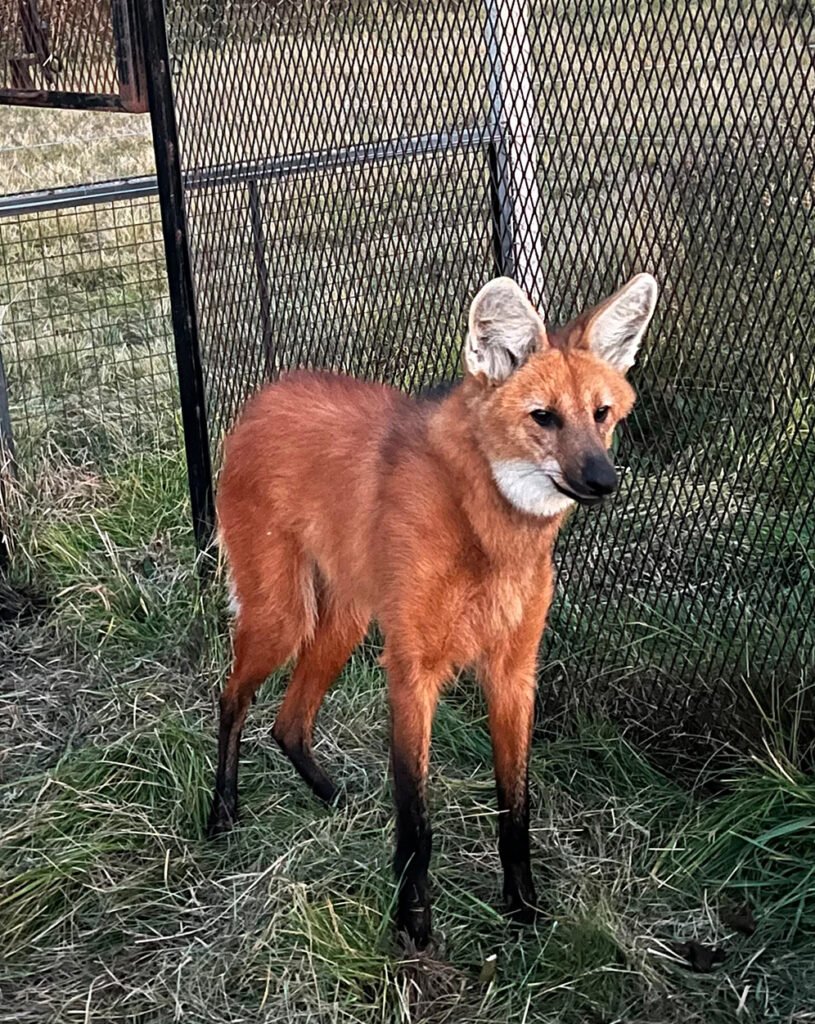
In July 2026, a tip from a neighbor led to the rescue of another maned wolf in the city of Gualeguay, Entre Ríos. The animal was transferred to the El Potrero Reserve, where it is currently undergoing a process of acclimatization and preparation for its return to the wild.
After an initial phase in an acclimatization enclosure, it was moved to a pre-release area of approximately three hectares, consisting of a natural environment and fenced off to allow for controlled monitoring. During this phase, we conduct continuous monitoring using camera traps and drones equipped with conventional and thermal cameras, striving to minimize contact with people.
It also receives supplemental food, although the environment contains natural prey that allows it to develop foraging behaviors.
The goal is for it to regain and maintain the skills necessary to thrive in the wild so that, when conditions are right, it can be released.
This animal will be released with a satellite tracking collar, which will provide information on its movements once it returns to the wild.
Conservation also means generating knowledge
The Maned Wolf Project at El Potrero Reserve aims to go beyond the rehabilitation and release of individuals.
Monitoring is a fundamental tool for achieving this. Through camera traps, drones, and—after release—satellite tracking collars, we can track the animals’ movements, the habitats they use, and some of the risks they face in the wild. Each monitoring effort provides new data and helps improve rehabilitation, release, and monitoring strategies, strengthening the knowledge needed to work toward the conservation of the maned wolf.
We work to build expertise, generate information, and strengthen a collaborative network that contributes to the conservation of the species in Entre Ríos. This involves working alongside provincial authorities, specialized professionals, researchers, and organizations with experience in maned wolf conservation.
It also involves responsibly evaluating each release, taking into account the animal’s characteristics, environmental conditions, habitat availability, and the potential for subsequent monitoring.
A long-term project
The conservation of a species is not achieved through a single release. It requires understanding its needs, protecting and restoring the habitats it uses, reducing threats, and gathering information that enables better decision-making.
At El Potrero, we view this project as a long-term process, because we need to continue learning about the species, its habitat, and the conditions necessary for the maned wolf to once again become part of the landscape of Entre Ríos.